Taoist Classics Explained – Tao Te Ching (Standard Edition)
Tao Te Ching: The Foundational Classic of Daoist Thought Tao Te Ching (also known as Laozi) is the foundational classic of Daoist philosophy. Within Daoism, its status is comparable to the Analects in Confucianism or the Diamond Sutra in Buddhism. It is the defining text that established Daoism as a distinct school of thought, and…
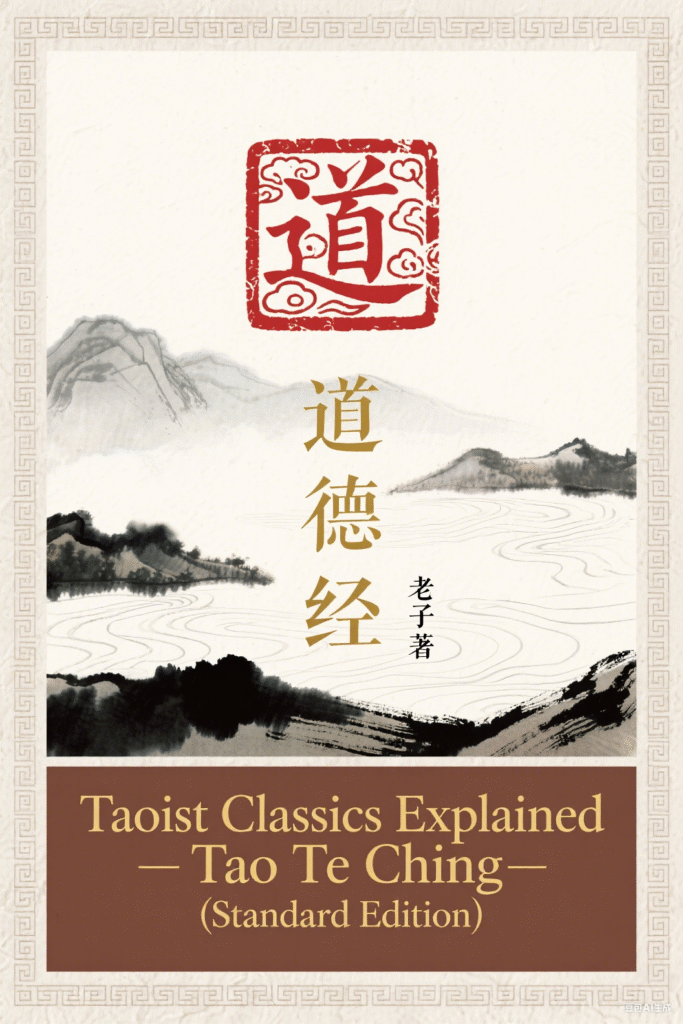
Tao Te Ching: The Foundational Classic of Daoist Thought
Tao Te Ching (also known as Laozi) is the foundational classic of Daoist philosophy. Within Daoism, its status is comparable to the Analects in Confucianism or the Diamond Sutra in Buddhism. It is the defining text that established Daoism as a distinct school of thought, and it has served as the “mother text” of Daoist philosophy from the pre-Qin era to the present day. Its core position can be analyzed through three dimensions: intellectual origin, theoretical framework, and lineage transmission.
I. Intellectual Origin: The “Genesis Text” of Daoism, Defining the Core Category of “Dao”
Before the appearance of the Tao Te Ching, the term Dao often appeared in early Chinese classics such as the Shang Shu and Shi Jing, usually meaning “road” or “method.” It had not yet been elevated to the core of a philosophical system. The Tao Te Ching was the first text to raise Dao into the ultimate category of cosmic origin, natural law, and life principle, thereby establishing the philosophical foundation of Daoism.
- It declares, “Dao gives birth to One; One gives birth to Two; Two gives birth to Three; Three gives birth to all things.” This cosmological insight became the cornerstone for later Daoist (and Daoist religious) explanations of the origin of all things.
- It emphasizes “Dao follows Nature” (Dao fa ziran), affirming “naturalness” and “non-action” (wu wei) as the central principles of Daoist thought. These principles became the inner core of early Daoist philosophy (such as Zhuangzi) and continued to influence later traditions such as Wei-Jin Xuanxue and Daoist religious practice.
Without the Tao Te Ching’s philosophical elevation of Dao, there would be no “Daoist school” as an independent intellectual tradition. All later branches of Daoism trace their theoretical starting point to the interpretations and extensions of Dao as presented in the Tao Te Ching.
II. Theoretical Framework: The “General Outline” of Daoist Philosophy, Covering Cosmos, Society, and Life
Although the Tao Te Ching contains only about 5,000 characters, it presents a complete and self-consistent theoretical system. It set the agenda and values for Daoist thought, and later Daoist developments were essentially elaborations and reinterpretations of this framework:
- Cosmology: With Dao as the ultimate origin, it asserts “Reversal is the movement of Dao” (fan zhe dao zhi dong), describing cyclical transformation as the law of all things. It denies the existence of an external creator and emphasizes natural evolution—distinguishing Daoism from the Confucian concept of Heaven’s Mandate (tian ming) and the Mohist Will of Heaven (tian zhi).
- Social Philosophy: Opposing the Confucian reliance on moral codes (ren, yi, li, zhi), it advocates for “small states with few people” and “governing through non-action,” arguing that excessive human interference destroys natural order. This became a critical intellectual resource against authoritarian rule in pre-Qin Daoist texts like Wenzi and Heguanzi.
- Philosophy of Life: It promotes cultivating stillness and simplicity—“Attain utmost emptiness; hold fast to stillness”—pursuing a life of “embracing simplicity and reducing desires.” Harmony between the individual and nature is achieved by following Dao. Zhuangzi later developed this into the ideal of Xiaoyao you (wandering freely), while Daoist religion incorporated it into inner alchemy and self-cultivation.
From the “Huang-Lao” school of the Han dynasty (which blended Daoist wu wei with Legalist techniques of governance), to Wei-Jin Xuanxue (which centered on commentaries of Laozi, Zhuangzi, and Yijing), all Daoist intellectual currents essentially reinterpreted the theoretical structure originally defined by the Tao Te Ching.
III. Lineage Transmission: The Bridge Between Daoist Philosophy and Daoist Religion
Daoism’s development may be divided into philosophical Daoism (from pre-Qin to Wei-Jin) and religious Daoism (Daoism as a religion, beginning in the Eastern Han). The Tao Te Ching served as the key link ensuring continuity between these two phases:
- Influence on Philosophical Daoism:
- Zhuangzi built upon the Dao in the Tao Te Ching, extending the idea of naturalness and non-action to the realm of individual spiritual freedom.
- The Huang-Lao school of the late Warring States and early Han dynasty applied wu wei to statecraft, influencing the Han dynasty’s policies of “rest and recuperation.”
- Wei-Jin Xuanxue scholars such as Wang Bi and Guo Xiang focused heavily on commenting on the Tao Te Ching, merging Daoist cosmology with Confucian social ethics, making it the dominant intellectual current of their time.
- Influence on Religious Daoism:
- With the founding of Daoist religion in the Eastern Han (e.g., Zhang Daoling’s Way of the Five Pecks of Rice), the Tao Te Ching was elevated as the Daoist “scripture,” often called the Laozi Tao Te Ching.
- Dao was deified into the Three Pure Ones (with Yuanshi Tianzun as its highest personification), while wu wei was ritualized into spiritual practices such as meditation, shoujing (guarding stillness), and baoyi (embracing the One).
- Later Daoist traditions—Tang Daoism emphasizing Xuanxue, Song dynasty Inner Alchemy, Ming-Qing Daoist health cultivation—all continued to regard the Tao Te Ching as their ultimate scripture, comparable in status to the Bible in Christianity or the Qur’an in Islam.
Even in modern times, the Tao Te Ching remains the central text of Daoist philosophy and culture. Whether in academic research or in popular adoption of ideas like “follow nature” and “contentment brings happiness,” its influence is ubiquitous.
Conclusion: The Tao Te Ching as Daoism’s “Genetic Code”
If Daoism is likened to a great tree, the Tao Te Ching is its root. It not only gave rise to Daoism’s fundamental concepts (Dao), theoretical framework (cosmos–society–life), and intellectual lineages, but also ensured continuity from philosophy to religion, from antiquity to modernity. Without the Tao Te Ching, Daoism would lack its point of origin and defining identity. All later innovations and developments in Daoist thought are essentially “returning to and renewing” the ideas of the Tao Te Ching.
Thus, the Tao Te Ching is not only the first classic of Daoism, but the very foundation upon which Daoism exists.
The Tao Te Ching, written over 2,500 years ago by Laozi, is one of the most influential classics in world philosophy. For centuries, scholars, monks, and seekers have turned to its verses to explore the nature of the universe, society, and the human spirit. Starting today, I will share a series of interpretations of the Tao Te Ching—drawing from different versions, schools of thought, and historical contexts. My goal is to help you uncover the timeless wisdom of the ancient Chinese sages, and to see how these teachings can still inspire our modern lives.