Tao Te Ching Chinese English Parallel Text | Bilingual Edition|Tao Te Ching – Dao Jing, Chapter 5
《道德经》第五章Tao Te Ching – Chapter 5 原文 (Classical Chinese):天地不仁,以万物为刍狗;圣人不仁,以百姓为刍狗。 天地之间,其犹橐籥乎?虚而不屈,动而愈出。 多言数穷,不如守中。 English Translation:Heaven and Earth are impartial;They treat all things as straw dogs. The Sage is also impartial;He treats the people as straw dogs. Between Heaven and Earth, is it not like a bellows?Empty, yet never exhausted;The more it moves, the more it produces. Too…
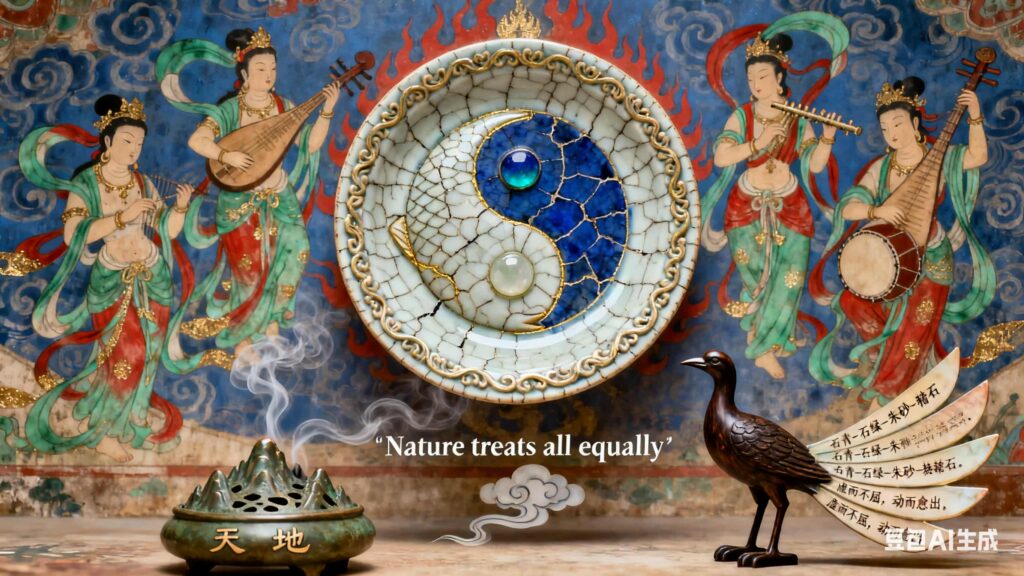
《道德经》第五章Tao Te Ching – Chapter 5
原文 (Classical Chinese):
天地不仁,以万物为刍狗;
圣人不仁,以百姓为刍狗。
天地之间,其犹橐籥乎?
虚而不屈,动而愈出。
多言数穷,不如守中。
English Translation:
Heaven and Earth are impartial;
They treat all things as straw dogs.
The Sage is also impartial;
He treats the people as straw dogs.
Between Heaven and Earth, is it not like a bellows?
Empty, yet never exhausted;
The more it moves, the more it produces.
Too many words lead to exhaustion.
Better to hold to the center.
白话文解释 (Modern Chinese Explanation):
天地无所谓仁爱,它们把万物当作祭祀用的草狗,没有特殊的偏爱。圣人效法天地,也无所谓偏爱,他把百姓看作和万物一样,没有区别对待。
天地之间好像一个风箱的皮囊,虽然是空的,但不会枯竭;越是鼓动,它产生的力量就越多。政令和言辞太多反而让人困惑、无所适从,不如保持中正、虚静的态度。
Plain English Commentary:
In Chapter 5, Laozi teaches that both Heaven and Earth are impartial, treating all beings without preference, like straw dogs used in ancient rituals—once valued, then discarded. The Sage follows this same principle, governing without favoritism.
The Tao is like a great bellows: empty yet inexhaustible, producing more the more it is moved. Too many words, rules, or doctrines only create confusion. True wisdom lies in simplicity, balance, and holding to the center.