Tao Te Ching Chinese English Parallel Text | Bilingual Edition|Tao Te Ching – Dao Jing, Chapter 3
《道德经》第三章 Tao Te Ching – Chapter 3 原文 (Classical Chinese):不尚贤,使民不争;不贵难得之货,使民不为盗;不见可欲,使民心不乱。 是以圣人之治,虚其心,实其腹;弱其志,强其骨。常使民无知无欲。使夫知者不敢为也。为无为,则无不治。 English Translation:Do not exalt the worthy, and the people will not compete.Do not value rare treasures, and the people will not steal.Do not display what is desirable, and the people’s hearts will not be disturbed. Therefore, in governing, the Sage empties the people’s minds…
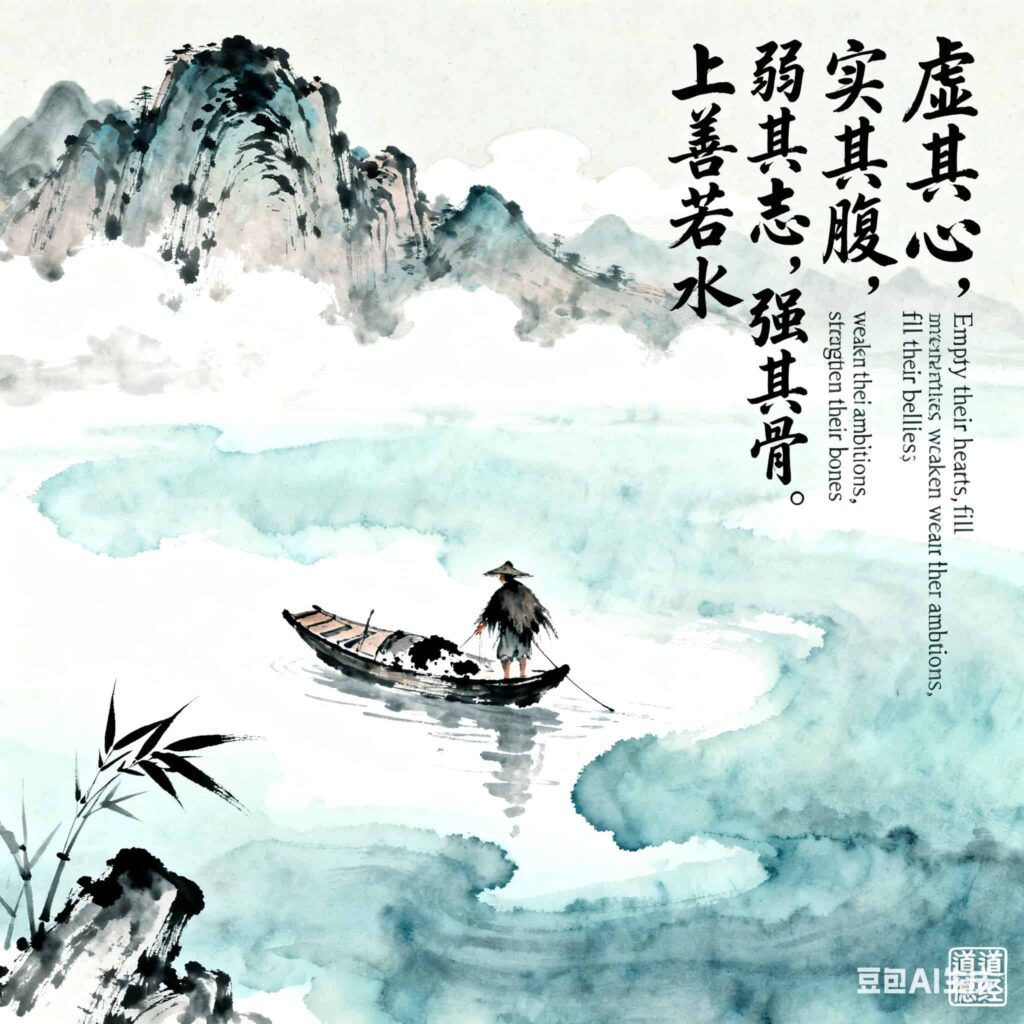
《道德经》第三章 Tao Te Ching – Chapter 3
原文 (Classical Chinese):
不尚贤,使民不争;
不贵难得之货,使民不为盗;
不见可欲,使民心不乱。
是以圣人之治,虚其心,实其腹;
弱其志,强其骨。
常使民无知无欲。
使夫知者不敢为也。
为无为,则无不治。
English Translation:
Do not exalt the worthy, and the people will not compete.
Do not value rare treasures, and the people will not steal.
Do not display what is desirable, and the people’s hearts will not be disturbed.
Therefore, in governing, the Sage empties the people’s minds and fills their bellies,
Weakens their ambition and strengthens their bodies.
He always keeps the people free from knowledge and desire,
So that the clever do not dare to act recklessly.
By governing with wu wei (non-action), nothing is left ungoverned.
白话文解释 (Modern Chinese Explanation):
不推崇贤能,百姓就不会为了地位和利益而争斗;
不珍视稀有的财物,百姓就不会萌生偷盗之心;
不展示令人贪恋的事物,百姓的内心就不会被欲望搅乱。
因此,圣人的治理方法是:让百姓内心宁静而饮食充足;削弱他们过度的野心,却让他们的身体强健。
让百姓保持质朴无欲,使那些自作聪明的人不敢妄为。
用“无为”的态度治理天下,就没有治理不了的事情。
Plain English Commentary:
Laozi explains in Chapter 3 that good governance avoids stirring up desire and competition. When leaders do not glorify status, treasure, or luxury, the people live without conflict or theft. The Sage governs by nourishing the body and calming the mind, reducing ambition while strengthening life itself. By practicing wu wei—action in harmony with the natural order—order arises effortlessly, and nothing is left unmanaged.